The Secret Pot Behind Every Banging Balti: Inside the BIR Base Gravy

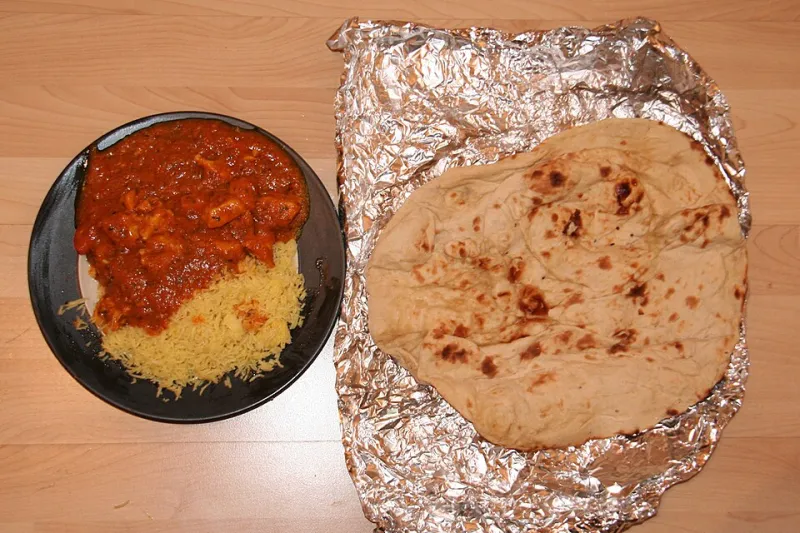
Photo: Des Blenkinsopp , CC BY-SA 2.0, via Wikimedia Commons
There is a quiet hero in every British Indian restaurant. It does not arrive at your table in a sizzling iron dish. It does not get a mention on the menu. It sits in a big pot at the back, bubbling gently, smelling like the best possible version of a Sunday afternoon. It is BIR base gravy, and once you know about it, your takeaway order never quite looks the same again.
What Exactly Is BIR Base Gravy?
BIR stands for British Indian Restaurant. It is the cooking style behind the curry you know and love: the chicken tikka masala, the lamb rogan josh, the vindaloo that makes your mate sweat through his shirt. The base gravy is the shared foundation. It is a slow-cooked, heavily reduced sauce made from onions, carrots, peppers, tomatoes, spices and stock. It is not a finished curry. It is the canvas.
On a busy Saturday night, a chef can take a ladle of base gravy, add a specific spice mix, a protein, maybe a splash of cream or a handful of green chillies, and knock out your curry in minutes. That is the magic of the BIR method: one pot, many endings. It is efficient, it is clever, and it is the reason your local can serve forty different dishes without forty different pans on the go.
Why It Makes Your Local Taste Like Your Local
Here is the bit that gets interesting. Base gravy is not a universal recipe. Every restaurant has its own version, and that version becomes the house style. One kitchen might char its onions harder for a darker, smokier base. Another might lean on more carrot for sweetness. A third might add a secret spoon of something they will never tell you about. The result is that two takeaways on the same street can make a chicken madras that tastes like it came from different postcodes.
That is not a flaw. It is the joy of it. The base gravy is the reason your Friday-night curry has a personality. It is also the reason a good takeaway can feel like a proper local institution rather than a generic food outlet. When people say a curry is 'proper' or 'tastes like it used to', they are often talking about a base gravy that has been honed over years. It is the unsung backbone of the whole operation.
The Regional Quirks Worth Knowing
Britain is not one curry culture. It is dozens of them, wearing the same menu. In Birmingham, the base gravy often has a deep, rounded savoury quality that suits the balti style. In Bradford, you might find a slightly more robust, spice-forward base. In Glasgow, the influence of the old shipyard canteens and the city's own curry history can show up in a thicker, sweeter gravy. London is a patchwork: Brick Lane classics, Southall Punjabi kitchens, Tooting and Wembley spots doing their own thing.
None of this is a strict rule. It is more like a set of local accents. The base gravy is where those accents live. It is also why a curry from your hometown can taste weirdly emotional when you have been away. You are not just tasting spice. You are tasting a kitchen's habits, a neighbourhood's preferences and a cook's stubborn belief that their way is the right way.
The Spice Boyz Base Gravy Benchmark
Want to know if your local is doing the good stuff? Try this entirely unscientific but deeply enjoyable checklist. Order a simple dish, ideally a chicken tikka masala or a plain chicken curry, and pay attention.
- Depth without heaviness. A good base gravy gives a curry body, not a brick. It should feel rich but not claggy. If you need a gallon of mango lassi to get through it, something is off.
- Layered spice, not just heat. You want to taste cumin, coriander, maybe a little fenugreek, a background hum of chilli. Heat should be a setting, not the whole personality.
- A clean finish. Proper base gravy has a savoury, slightly sweet, gently tangy finish. It should not taste raw or floury. If the sauce feels like it was thickened in a panic, walk away.
- Consistency across the menu. Try two different curries from the same place. If they taste like the same sauce with different food colouring, the base might be doing too much work. If they share a family resemblance but have their own character, that is a good sign.
- The next-day test. A great curry is often even better the next day. If the sauce separates into oil and sadness overnight, the balance was not there to begin with.
The Takeaway Truth
You are never going to get the base gravy recipe from your favourite chef, and that is fine. The mystery is part of the pleasure. What matters is that the pot behind the counter is doing its job: giving your curry a sense of place, a proper depth of flavour and that indefinable thing that makes you order from the same place again and again.
So next time your curry arrives, spare a thought for the big pot in the back. It did not ask for glory. It just quietly made your dinner taste like a Friday night should. That is worth raising a peshwari naan to.